[This is a guest post written by Elizabeth Roberts, a state registered dietician from www.fussyaboutfood.com]
Earlier on in the week I spoke to you about what causes fussy eating in Toddlers. Today I'm going to be delving into 6 ways to reduce fussy eating in toddlers.
Research shows that there are three key factors that help to reduce fussy eating in toddlers and young children (and I’ve added three from my own experience).

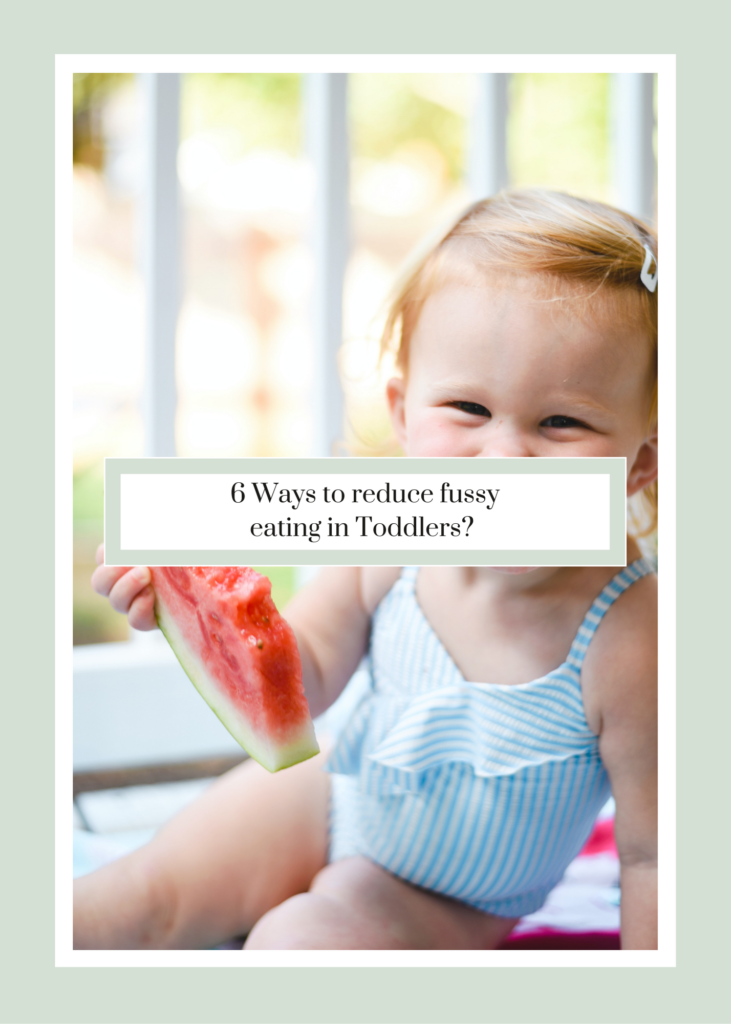
6 Ways to reduce fussy eating in Toddlers.
1.Repeated exposure to new foods.
One of the key methods for getting young children to learn to like new foods, tastes and textures is to expose them to the food many times.
There are various food ideas for picky toddlers, however we know that exposure to a new type of food makes children more likely to become familiar with it and, therefore, to like it. Some children need a little longer than others, and older children seem to need more exposures than younger children.
2.Exposure to food without eating.
Research has also shown that exposing children to new foods without actually eating the food can also help them to accept new foods.
Ways to do this can include taking her food shopping and letting her help by choosing foods and putting them in the trolley or basket. Looking at, and perhaps collecting, food pictures – in a magazine, a book, or online. Naming foods (either a picture or the actual food) has been shown to help young children be more accepting of a new type of food.
Seeing pictures of unfamiliar foods can increase a child’s willingness to try them. This is particularly helpful if the pictures are accompanied by a story about the food, like a food story book.
3.Watching role models eat and enjoy new foods.
Children learn by copying their parents. The younger the child, the more important the adult role models, especially trusted adults like parents. Chances are, if you don’t eat it, your child won’t either.
Role models have to be enjoying the new food, or at least pretending to! Researchers in France showed that 5 and 8 year old children liked a food less when an adult pretended to be disgusted by a food, even when the food was one they already liked.
Try to prepare family meals where everyone can enjoy the same thing. Young children have to see role models eating the same as them to increase their willingness to try something new.
It seems that the effects of seeing others eat go beyond the original meal, too – if a child sees other people eat the same food as him, then he is more likely to try it again at a later meal. What’s more, the effects of seeing our parents eating certain foods last into adulthood – we are more likely to like a food item now, even if we disliked the same food as a child, if we saw our parents eat that food.
4. Don’t offer alternatives.
Don't offer alternatives, but do offer regular meals and snacks and a few liked foods at each meal.
Offer a few safe foods and one or two new ones and let them help themselves. A study of 75 children aged between 2 and 4 years showed that structured mealtimes, where mums ate with the children and the children were allowed to help themselves from the foods on offer, showed fewer fussy eating behaviours.
5. Go steady on milk.
Milk fills children up, leaving less room for foods with other nutrients. Researchers studying a subset of children in the Avon Longitudinal Study of Parents and Children (also known as the Children of the 90s study), showed that the children who were fussy eaters drank more milk than their non-fussy counterparts. This was particularly obvious for those children who were fussy at 3½ years old, and still fussy at 7½ years old.
In the UK it is recommended that children aim for three servings of dairy per day that are appropriate for their age. For a young child, this might mean two small glasses of milk (150ml each) and a small pot of yoghurt or a small piece of cheese. For children under two, this should be full fat milk unless you have been specifically advised otherwise.
If you are looking for other calcium-containing foods, then check out the table at the bottom of the Food Fact Sheet produced by the British Dietetic Association.
6. Get some iron (and zinc).
Zinc and iron are important nutrients for children because of the links between both zinc and iron intake and appetite. Fussy eaters aged 3½ years old have been shown to have lower intakes of both iron and zinc than their non-fussy counterparts.
If you suspect your child has a deficiency of iron, then take him or her to the doctor and seek specialist medical or paediatric dietitian advice before offering supplements beyond the vitamins A, C, D as recommended by the Department of Health for children aged 6 months to 5 years old.
[This is a guest post written by Elizabeth Roberts, a state registered dietician from www.fussyaboutfood.com]

Disclaimer: The contents of this blog post apply to typically developing children who are not receiving medical or other healthcare professional treatment for eating or feeding difficulties and who are without food allergies. The content of this article is for informational purposes only and does not constitute medical or nutritional advice. Sources are available upon request.